 Skip to content
Geothermal Heat Pump
Save on your monthly heating costs right away with a heat pump—suitable for virtually any home—and take advantage of attractive rebates of up to €8,000.
with 257 reviews

- How It Works
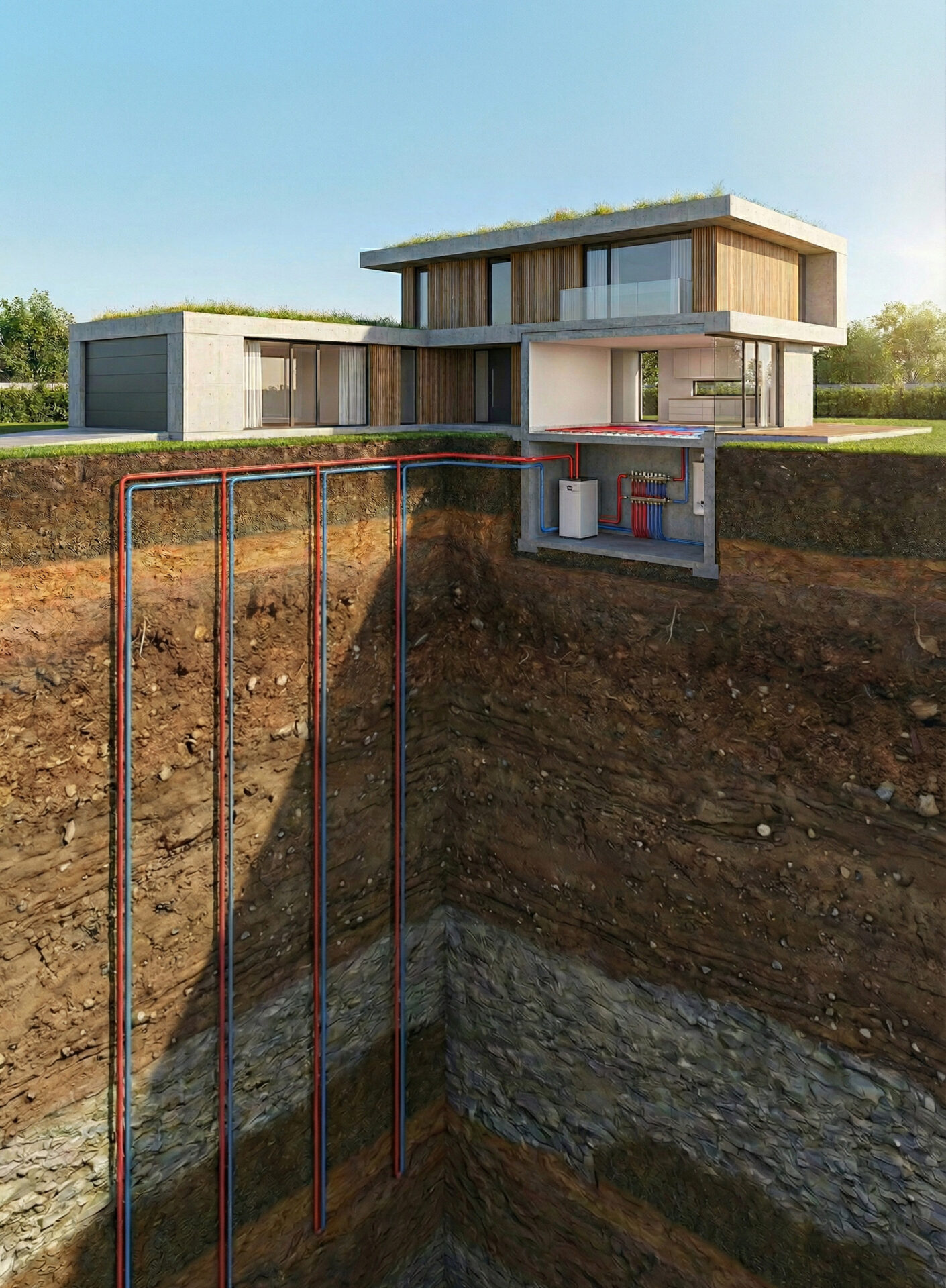
How does a geothermal heat pump work?
A geothermal heat pump extracts heat from the ground, where the temperature remains stable throughout the year. This energy is channeled to the heat pump via a closed-loop system and converted into usable heat for heating your home, providing hot water, or heating your pool.
Thanks to this principle, the system operates extremely efficiently and is not affected by the outside temperature. In addition, energy-efficient (passive) cooling is also possible.
- Advantages
Why choose a
Ground-water heat pump?
A ground-water heat pump is one of the most efficient heat pumps available on the market.
Long service life
Components are less exposed to the elements and wear and tear. A ground loop can easily last more than 50 years.
Stable returns
The ground temperature remains virtually constant throughout the year, allowing the heat pump to operate more efficiently. This results in a higher COP/SCOP and lower energy costs.
Silent as a whisper
Because there is no outdoor unit with a fan, the system operates virtually silently. This enhances living comfort and prevents noise pollution.
Passive cooling
The natural coolness of the ground can be used to cool the home in an energy-efficient way. The compressor remains off, which keeps energy consumption to a minimum.
High efficiency
A ground-source heat pump maintains its efficiency even in freezing weather. As a result, less supplemental electric heating is needed.
EPC value
A ground-source heat pump significantly contributes to a lower EPC score thanks to its high seasonal efficiency. This has a major impact on the home’s market value.

- How It Works
Find out if your home is suitable for a well
In many cases, geothermal drilling is possible, but certain practical constraints determine its feasibility. Both the available space and the subsoil play an important role.
Not sure if your home or garden is suitable? A site visit and technical analysis will quickly provide clarity.
- Step by step
How we operate:
From Analysis to Implementation
A geothermal project requires precision at every stage. Thanks to our thorough preliminary study and cost analysis, we guarantee technically optimal execution.
Site Visit
Every geothermal installation begins with a technically sound preliminary study. We analyze the heat demand, soil conditions, available space, and project requirements to determine the exact dimensions of the wellfield. During the site visit, we validate these calculations and carefully map out accessibility, drilling locations, and points of concern.
Vertical Drilling
The drilling is carried out according to the predetermined drilling plan. The depth, configuration, and positioning are perfectly aligned with the heat and efficiency calculations. This is essential for stable energy absorption and optimal operation of the heat pump. The duration of the work varies depending on soil conditions and project complexity.
Connecting the ground circuit
The vertical probes are hydraulically connected and routed to the utility room. The closed-loop system is filled with a water-glycol mixture to ensure efficient heat transfer and freeze protection. Pressure tests and inspections ensure the system’s reliability. This loop forms the basis of the installation.
Starting Up the Heat Pump
The heat pump is connected to the ground loop and the distribution system. During startup, we check flow rates, temperatures, and system pressures. Thanks to the precise preliminary analysis, the system operates within optimal parameters. This results in maximum efficiency and comfort.

- Premiums
Receive up to €8,000 in rebates for your heat pump
Did you know that in Belgium you can receive subsidies for installing a heat pump? Depending on your location, the type of heat pump, and your income bracket, a significant portion of your investment may be reimbursed. In addition, in most cases, the VAT rate on heat pumps is currently reduced to 6%, which makes the investment even more attractive.
- "My Heat Pump" Incentive (Flanders) up to €8,000
- RENOLUTION Grant (Brussels) up to €6,500
- Home Insurance Premiums (Wallonia) up to €3,600


- Reviews
What our customers say
More than 10,000 satisfied customers!

Excellent technical support. Quick quote and competitive pricing. Clean, high-quality work. A company I would recommend. Service first!

Fantastic team…the installation work was done very carefully…clear agreements that were honored…and very good prices, too! Top-notch company!!
Excellent service!
The quote, installation, and after-sales service all went very smoothly!

The most fantastic company I've ever worked with. From the customer service representatives on the phone to the installers—they all have just one goal: A SATISFIED CUSTOMER!
From the initial consultation to the installation, everything was perfect. Clear, accurate information; professional service. They really work with the customer to find the best solution. Highly recommended.
Perfect service. We received clear information in advance, including a site visit from the project engineer. The installation went very smoothly, and in my opinion, the staff was very knowledgeable.

I am extremely satisfied with the service provided. This company is customer-friendly, helpful in finding appropriate solutions, and highly competent.
Last week, Energyking installed a charging station at our home. The installation took place at the agreed-upon time, and the staff were friendly and professional.
We are very satisfied with our partnership with EnergyKing. Jo gave us a very clear explanation. Even after the installation, EnergyKing is always there for us!

A company you can count on! Efficient scheduling, friendly service, clear information both over the phone and in person, and always available to answer questions.

I just had an air conditioner installed by Energyking. Very satisfied!! Efficient workflow. Installed perfectly, finished neatly—and all at a competitive price!

Fast and professional service, and a very customer-friendly company! Thanks, Brecht, Joren, and Jan!
Energyking just finished installing a ground-water heat pump. For a relatively young company, they show a lot of maturity! I definitely recommend them.
I had an air conditioner installed by the team at Energyking. From our first contact through to the installation, everything went smoothly. Very professional work.
Everyone was very friendly, both on the phone and the people who came to give me a quote. Whenever I had questions, they were always there to help. I’m very satisfied!
Until March 2023, there was a 200% tax credit for companies that installed charging stations. They installed 22 professional charging stations. High quality, fast, and at a great price!

We are very satisfied with the proper and precise execution of the work, the fulfillment of agreements, and the responses to our questions and comments.
We contacted several companies about installing a charging station. We chose EnergyKing because their quote was clear and communication was smooth.
We're very satisfied with this partnership. Communication went smoothly, and our solar panels were delivered quickly (compared to other companies)! Top-notch service.
I had a very pleasant experience working with EnergyKing, which was recommended by a friend. Clear communication, quick installation, and the quote and invoice were straightforward.
A top-notch experience from start to finish. They followed through perfectly on all agreements, promises, and timelines, with excellent communication! I’m really, really satisfied with this company!

Our solar panels were installed last December. The technicians were very friendly and worked efficiently. I am very satisfied with my installation.

From the initial consultation to installation and inspection, everyone involved was highly skilled and knew how to get the job done. It was a complete end-to-end process with excellent communication throughout.

- FAQ
Frequently Asked Questions About Heat Pumps
Can you cool a room with a heat pump?
Yes, both air-to-water and ground-to-water heat pumps can also cool your home in the summer.
- In an air-to-water heat pump, this is achieved through active cooling, during which the system operates in reverse mode.
- With a ground-source heat pump, passive cooling is often possible as well, utilizing the natural coolness of the ground.
Important to know: A heat pump’s cooling capacity is less intense than that of a traditional air conditioning system. You shouldn’t expect a temperature drop of 10°C, but rather a pleasant reduction of a few degrees, which is often enough to ensure comfort on hot days. It’s ideal when combined with underfloor heating or fan coil units that are also suitable for cooling.
Does a heat pump also work in combination with high-temperature heating systems?
Heat pumps are most efficient when used for low-temperature heating systems, such as radiant floor heating or modified radiators.
But we also offer high-temperature heat pumps with a supply temperature of up to 70°C. They’re ideal for replacing your gas or oil boiler and work perfectly with your existing radiators.
Please note: these systems may consume more electricity than standard heat pumps. When renovating, we’d be happy to work with you to determine whether your existing heating system is compatible or needs to be replaced.
Are there subsidies for heat pumps in Flanders?
Yes, as a private individual, you can take advantage of several attractive support measures in Flanders:
- My Renovation Rebate (for applications submitted on or after July 1, 2025)
- Geothermal heat pump: incentive of up to €8,000
- Air-to-water heat pump: subsidy of up to €6,000
- Hybrid heat pump: incentive of up to €4,000
- Air-to-air heat pump: subsidy of up to €600
- Reduced VAT rate of 6% for homes older than 10 years
- Starting in 2026, this will also apply to homes less than 10 years old
- Fluvius Retroactive Investment Grant (Applications accepted through December 31, 2025)
- Up to €1,163 if you have a heat pump and solar panels with a digital meter
Please note! To be eligible for the Flemish incentives, your heat pump must be installed by a RESCert-certified installersuch as EnergyKing.
Do I need a permit for a heat pump?
In most cases, you do not need a permit to install a heat pump in your home. There are, however, a few exceptions:
- Ground-water heat pumps (with vertical boreholes) usually require a notification or permit from the Flemish Environment Agency, because drilling takes place underground.
- Air-to-water heat pumps generally do not require a permit, but you must take noise standards into account (especially if the outdoor unit is located close to a property line).
In the case of new construction or major renovations, the heat pump must, of course, be included in the EPB report.
How loud is a heat pump?
The noise level of a heat pump depends on the type of unit and where it is installed:
- An air-to-water heat pump has an outdoor unit that makes noise, similar to an air conditioner. At a distance of 5 meters, the noise level is usually between 35 and 50 decibels (comparable to a soft murmur or a refrigerator). Inside, you generally won’t be bothered by the noise, since the indoor unit operates very quietly and is usually installed in a storage room or utility room.
- A ground-water heat pump operates almost silently because it does not require an outdoor unit.

Waiting...
It costs money!
- Our Blog
School of Energy
- 4 min
Do you have a problem?
We'll fix it today!
Please feel free to contact us. We'd be happy to help you!