 Skip to content
What does a negative electricity price mean?
A negative electricity price sounds paradoxical, but the mechanism behind it is simple. It occurs when more electricity is generated than is needed at that moment. Because the power grid must always remain perfectly balanced, generators pay to offload their electricity in such a situation.
Important: This refers to the wholesale market. It does not necessarily reflect the price that households and businesses see on their energy bills.
Why is this happening right now?
It is no coincidence that this record was set in late April. On the contrary: it is a sign of things to come in the months ahead.
We're already seeing the typical combination associated with spring and summer:
- Increased Solar Power Generation Due to Longer Days
- Lower demand, especially on weekends
- A growing share of renewable energy without sufficient flexibility
What used to be mainly a summer phenomenon is now already starting to appear in the spring and will only increase as summer approaches.
This will not be an exception, but a pattern
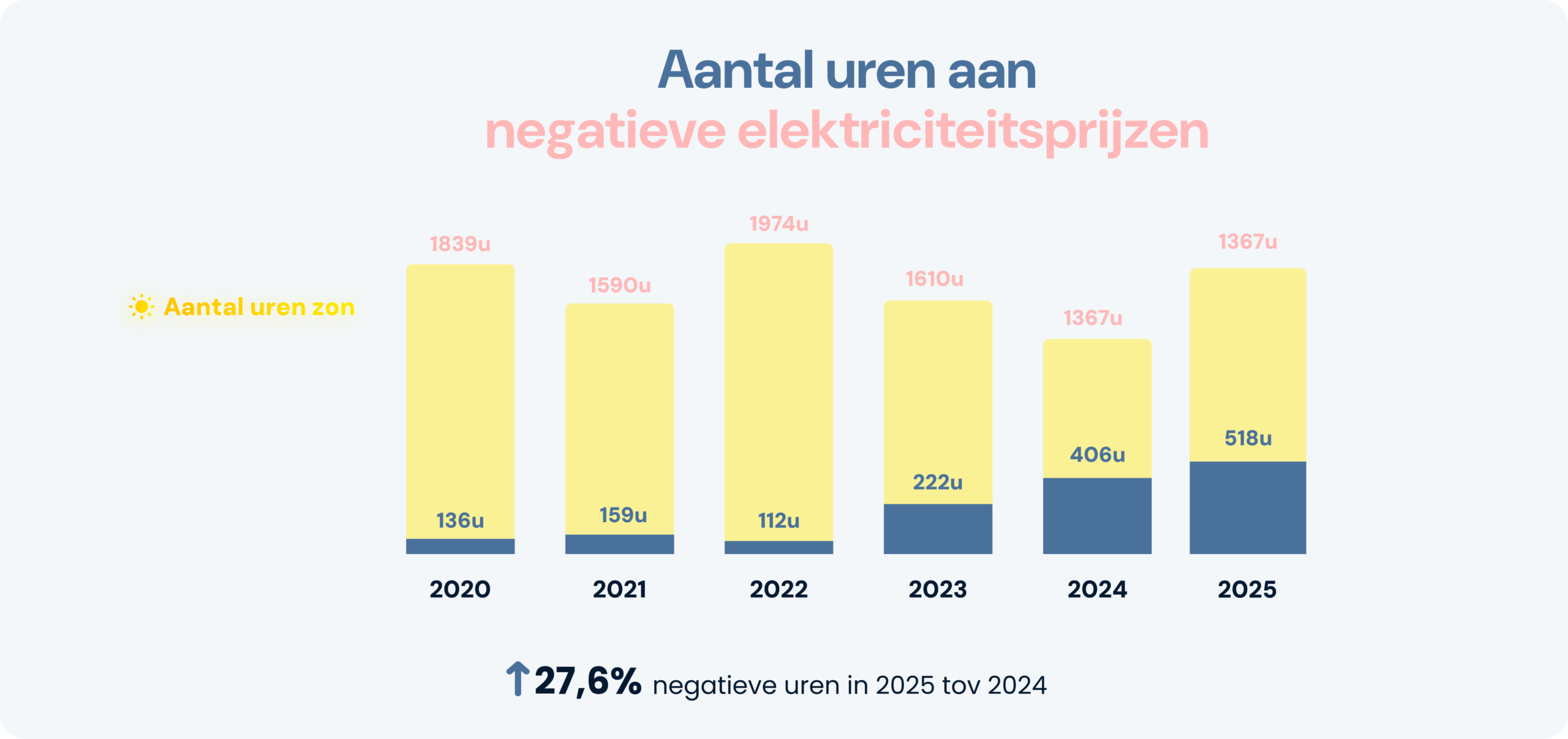
Negative electricity prices are becoming increasingly common. In 2025, they already totaled 518 hours, a 27.6% increase from the previous year. This trend clearly shows how surpluses on the grid are occurring more frequently, mainly due to the growth of solar energy during the spring and summer months.
What this actually shows is that it’s not a temporary spike, but a clear trend in the market. And that’s exactly why this isn’t an exception, but a pattern.
Negative electricity prices are not a one-time anomaly. They are part of a broader evolution of our energy system. As more households and businesses invest in solar panels, generation will continue to rise during sunny periods. At the same time, demand often lags behind, especially during the day.
The result? More instances where there is simply too much electricity.
 Not everyone feels this way
Although “getting paid to use electricity” sounds appealing, the impact depends heavily on your contract.
Dynamic Contracts
Anyone who has a dynamic energy contract can take advantage of these opportunities:
- Charging an electric car
- Run the washing machine
- Charging a home battery
Because the price per hour fluctuates, energy consumption can be intentionally shifted to the cheapest (or even negative) times. This makes it possible to directly benefit from fluctuations in the energy market.
Fixed-rate or variable-rate contracts
Negative prices are usually not visible here. The price you pay is based on averages or fixed agreements, so fluctuations every 15 minutes do not have a direct impact on your bill.
Solar Panel Owners
Sometimes you have to pay to feed electricity into the grid when prices are negative. This happens when generation is so high that the grid becomes overloaded, and feeding electricity into the grid at that moment no longer has any value.
Daily Rate vs. Hourly Rate: An Important Difference
Many people look at average daily prices and don't see any negative values there. That's true, but it doesn't tell the whole story.
Electricity is traded on a quarter-hourly basis, which means there can be both peaks and troughs within a single day. Negative prices can therefore easily occur for a few hours, while the daily average remains positive.
This explains why these moments are often less visible in traditional overviews, even though they are actually becoming more common and increasingly important to those actively involved in energy consumption.
The paradox: a surplus and imports
While Belgium has a surplus of solar energy during the day, it remains dependent on imports in the evening and at night.
- During the day: too much production
- In the evening: insufficient production
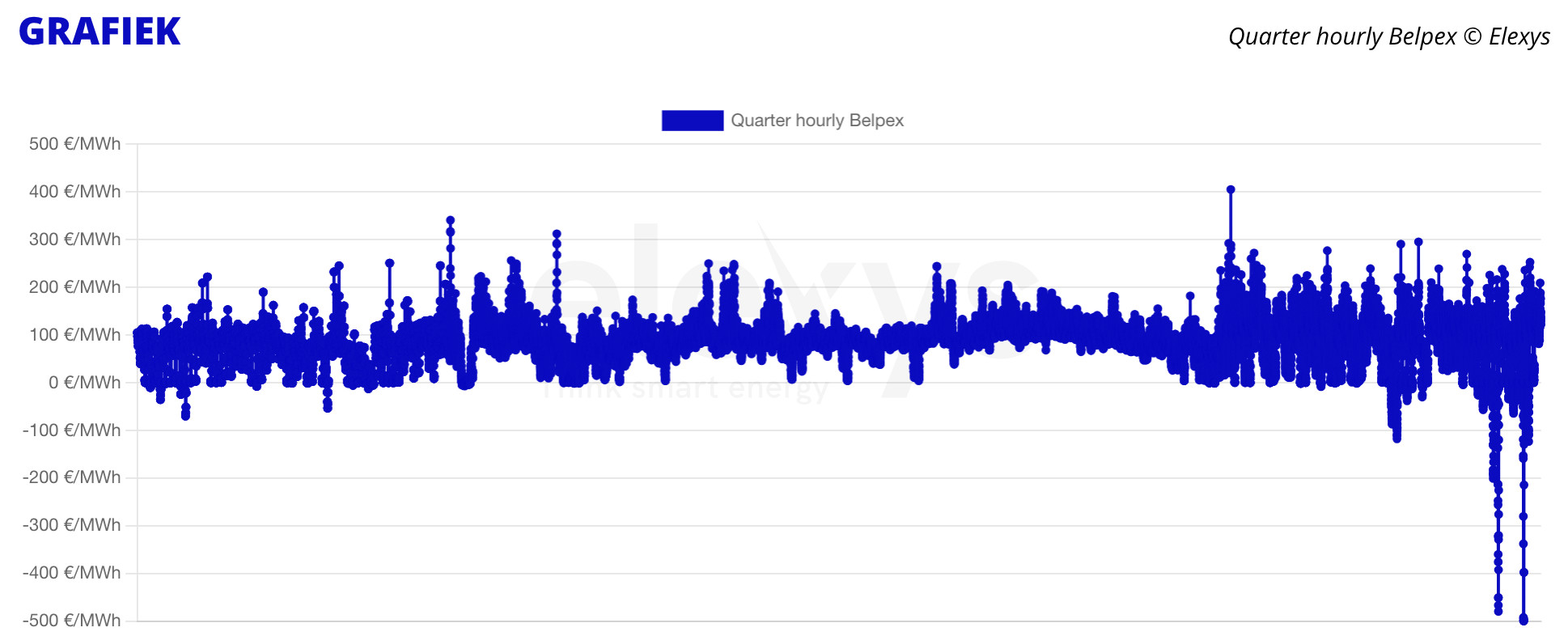
The quarter prices at the Belpex quarter-hour market show how supply and demand fluctuate. Last weekend, prices plunged to -500 €/MWh due to a surplus of solar energy. At the same time, Belgium remains dependent on imports at other times—a matter of timing, not capacity.
More infrastructure alone is not enough
Investments in networks are important, but they are not enough. Without storage, smart control, and flexible consumption, the system will remain out of balance.
Solutions such as home batteries and smart energy management are therefore crucial.
The real lesson: timing is everything
What we're seeing today isn't a mistake—it's a sign. In an energy system with plenty of sun and wind, timing is more important than ever. It's not how much energy you use, but when.
Conclusion: Summer will be the real test
The fact that electricity prices are already plunging so far below zero in early May is no coincidence. It is a clear sign of what the coming months will bring.
Summer will reinforce this trend:
- more sunshine
- increased production
- more surpluses
And so: negative prices more often.
Anyone who prepares for this, for example through energy management or smart contracts, can benefit from this. For others, it remains largely invisible, but that doesn’t make it any less important.
Electricity prices below zero are no longer an exception.
This is a sign that our energy system is in the midst of a transition and that flexibility is becoming key.


