 Skip to content
What is bidirectional charging?
Bidirectional charging means that an electric vehicle can not only draw energy but also feed it back into the grid. Thanks to this technology, your electric vehicle can function as a home battery, allowing you to use the stored electricity flexibly. The energy in the battery can be used again in your home or fed back into the grid.
There are a few requirements for bidirectional charging. You need a bidirectional charging station and an electric vehicle that supports this technology. Currently, only a limited number of models are compatible, but the selection is growing.
The various forms of bidirectional charging are often grouped under three terms:
Vehicle-to-Load (V2L)
V2L allows you to connect devices and appliances directly to your electric car. Think of charging a laptop, using power tools on a construction site, or plugging in lights during a camping trip. This turns your car into a mobile power source that can be used anywhere, without having to rely on a fixed power outlet.
Vehicle-to-Home (V2H)
With V2H, your electric car feeds energy back into your home. Your car’s battery can then serve as a home battery, with the stored electricity being reused to power your household. This is particularly beneficial during peak times or when electricity prices are high, allowing you to save money and increase your self-consumption.
Vehicle-to-Grid (V2G)
With V2G, your car’s battery is used to feed electricity back into the grid. This helps stabilize the grid by balancing out peaks and troughs in demand. For companies with multiple electric vehicles, this can provide significant added value, but individuals will also be able to benefit in the future through dynamic energy contracts or payments from grid operators.
Who might be interested in bidirectional charging?
Bidirectional charging is particularly beneficial for families with an electric car and solar panels. They can store the excess solar energy generated during the day in their car and use it later in their home. In this way, the car acts as a home battery, reducing your dependence on the grid and helping you lower your energy bill.
In addition, bidirectional charging is appealing to families who want to be more self-sufficient or who want to take advantage of dynamic energy prices by using electricity when it’s cheaper and feeding it back into the grid when prices are higher.
.
Why Bidirectional Charging Will Still Be Limited in 2025
In 2025, bidirectional charging will not yet be widely available. This is because there are various technical, economic, and legal barriers that are slowing down its widespread rollout. The main reasons why bidirectional charging is not yet available today are as follows:
- Legal complications
Currently, bidirectional charging in Belgium is still a regulatory gray area. The legal framework surrounding V2G and V2H has not yet been fully developed, leaving a great deal of uncertainty. Any device that feeds electricity back into the grid (such as inverters, home batteries, and bidirectional charging stations) must first be certified (officially approved) by Synergrid.Since bidirectional DC charging stations are not yet included on the Synergrid list, they are not currently permitted to feed energy back into the grid.
When it comes to AC charging—where the inverter in the vehicle itself converts the electricity and feeds it back to the home or the grid—that specific vehicle inverter must also undergo a certification process with Synergrid. To date, however, no car model has been officially certified for feeding electricity back into the Belgian power grid.
In addition, the technical connection requirements of distribution system operators (such as Fluvius) have not yet been adapted to mobile energy sources such as electric vehicles. There is a lack of clear rules regarding metering, feed-in limits, and safety.
Software and Communication
To exchange energy safely and intelligently, the vehicle must continuously communicate with both the charging station and the grid operator or an energy management system. This is done through protocols that determine how much power can be fed back into the grid and when. Without this smart communication, energy cannot be fed back to the home or the grid in a controlled manner.
Battery Life Each charge and discharge cycle affects the battery’s condition. Bidirectional charging adds extra cycles, which can cause the battery to wear out faster. Manufacturers are therefore cautious: some impose a limit in the form of a maximum number of kWh that can be used for feeding power back into the home, or in the form of a maximum total number of discharge hours.Finally, compatibility also plays a role: some electric cars are technically perfectly capable of bidirectional charging, but the manufacturer blocks this option via software. This is often due to strategic decisions, waiting for regulations to be finalized, or protecting commercial interests. That is why it is crucial for manufacturers of both cars and charging stations to collaborate, so that there will be more opportunities for bidirectional charging in the future.
What bidirectional charging stations are available today?
A bidirectional charging station is a charging station that can not only supply power to your electric car, but also feed energy back from the car's battery to your home or even to the power grid.
AC and DC bidirectional charging stations
Bidirectional charging is possible with both AC and DC chargers. With AC charging stations, the inverter is located in the vehicle itself, which means that only models with a bidirectional onboard inverter support this feature. With DC charging stations, the smart inverter is located in the charging station itself, making it technically easier to charge bidirectionally with different vehicles. However, DC charging stations are more expensive and more complex than AC versions.
Our bidirectional charging stations
Today, most of EnergyKing’s charging stations are already V2G-ready (either as standard or as an optional feature). This means they are technically capable of bidirectional charging, but the feature cannot be fully utilized until the regulations governing power feed-in are in place and automakers officially allow this option. At this time, that is not yet the case.
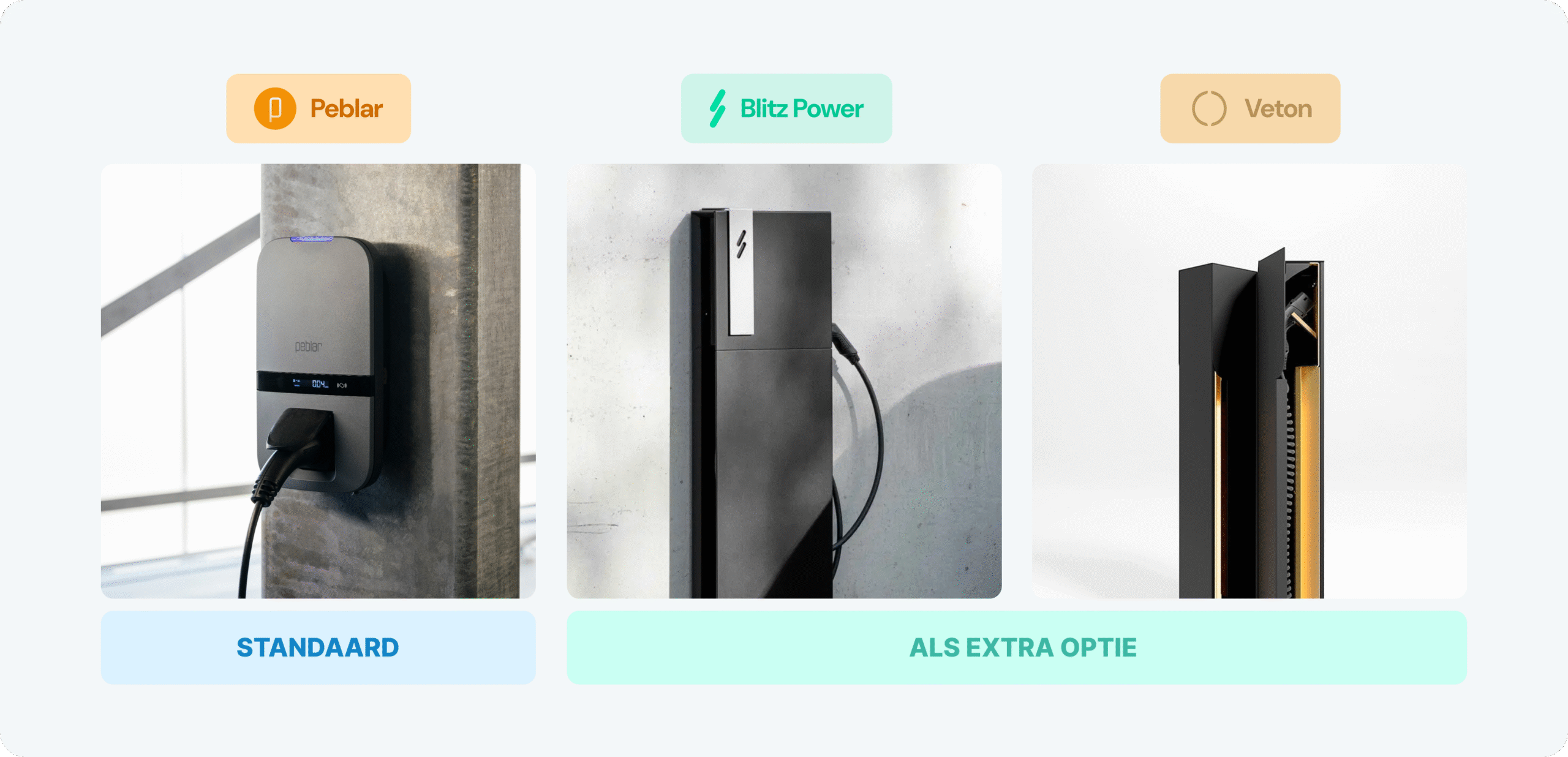
Want to be ready for bidirectional charging right now? Then choose the Peblar Business: a smart and affordable charging solution that comes V2G-ready as standard, allowing you to take the first step toward a future-proof charging solution today. Request a no-obligation quote now.
With Blitz Power and Veton, bidirectional charging can be added as an optional feature. This allows you to set up your charging station for V2G in advance.
Alfen will soon be launching bidirectional charging stations as well. In doing so, they are preparing their product lineup for the new standard and offering customers a future-proof solution.
Start saving now by charging smarter?
Bidirectional charging is technically promising, but its availability is still limited at this time. With smart charging, however, you can already lower your energy costs. But what exactly is the difference between bidirectional charging and smart charging? Bidirectional charging allows your car to feed energy back into the grid, while smart charging determines the best way and time to charge.
This includes smart features such as load balancing, which automatically adjusts the charging power to prevent overloading. Peak shaving helps you avoid peak consumption and prevents extra charges on your energy bill. You can also charge using solar energy, allowing you to make the most of your own green electricity. Another option is charging based on dynamic rates, which ensures your car charges primarily when electricity is cheapest.
Conclusion
Bidirectional charging is a promising technology that allows families to use their electric cars as home batteries as well. Although many charging stations and an increasing number of cars are already V2G-ready, its practical application in Belgium is still in its infancy. Technical requirements, vehicle compatibility, and—above all—legislation mean that there are still very few concrete examples today.
Still, it’s clear that bidirectional charging will play an important role in the energy transition. Anyone who chooses a V2G-ready charging station now is prepared for the future and, in the meantime, can already save on their energy bill thanks to smart charging features.
At EnergyKing, we’re closely monitoring these developments and offering charging solutions that are ready for bidirectional charging as soon as the market is ready. This way, you can get the most out of your electric car today, with the assurance that you’re ready for tomorrow.


